You may have gotten a small sense of how amazing cockroaches are.
We were talking about moisture and what the "melting layer" could be inspiring for, but in fact the shape or qualities of the legs of cockroaches were adapted to robots.
Scientists first thought that the shape of the cockroach's
legs is sensory,
but it was proved that they help these insects to walk on difficult terrain. Here are two articles that topic:
http://www.livescience.com/5991-future-robots-run-cockroaches.html
http://www.treehugger.com/clean-technology/cockroach-legs-inspire-robotic-hands-grip-action.html
Marcus Hubl
Picture taken from http://www.flickr.com/photos/lecates/1425467282/
Showing posts with label week2. Show all posts
29 February 2012
28 February 2012
Water cleaning with sunlight
Algal turf scrubber - water purifer
"Algal turf scrubbers are field-sized, water-treatment systems that can extract excess nutrients from streams, canals, and lakes polluted by agricultural, domestic, and some industrial runoff. They use sunlight as their principal source of energy and simultaneously restore oxygen levels. The devices work by pulsing contaminated water across algae that are allowed to grow on screens. Algal turf scrubbers produce waste suitable for use as a nitrogen- and phosphorus-rich fertilizer and for conversion to biofuel or high-value nutraceuticals. Some algal turf scrubbers can even operate in open water, thus minimizing loss of agricultural land to the systems." (source: "Algal turf scrubbers clean water with sunlight," EurekaAlert)
Algal turf scrubbers (ATS) have been used for water quality improvement since the 1980s. They integrated water flow and surge with high light intensity and frequent harvest to reach high levels of primary productivity and control water quality in a considerable variety of enclosed microcosms and mesocosms of coral reefs, estuaries, rocky shores, and freshwater systems. HydroMentia, Inc. has ATS that can handle 1 to 25 million gallons to day and when combined into a single facility can clean hundreds of millions of gallons per day.
Adey WH; Kangas PC; Mulbry W. 2011
_Berta Pérez Gumà
Armadillo
Armadillo
The
armadillo is a 12 to 15 centimetre long mammal with a leathery armour shell made
of keratin. The word armadillo in Spanish means "little armoured one"
and the animal is primarily found in South and Central America, particularly in
Paraguay and surrounding areas.
The armour
is formed by plates of dermal bone (keratin) covered in relatively small,
overlapping epidermal scales called "scutes". Most species have rigid
shields over the shoulders and hips and a number of bands separated by flexible
skin cover the back and flanks. Additional armour covers the top of the head,
the upper parts of the limbs, and the tail. The underside of the animal is
never armoured, and is simply covered with soft skin and fur.
The
armadillo rely heavily on its armour for protection and when it feel threatened
it simply rolls up into a ball protecting the vulnerable and vital organs and
limbs, presenting a predator with a frustrating ball game instead of a meal.
This type
of structure could be used in a number of different ways from bendable to adaptable
facades to foldable photovoltaic cells.
Other uses
can be casts for broken bones that protect the skin beneath, protective
equipment etc.
by Cecilia Rudstrom
The Plant, Chicago
Learning
about the Able Project and other projects that focus on using waste as a resource
in this week’s lecture reminded me of The Plant, a vertical farm in Chicago. The
Plant is housed in an old meat-packing warehouse and also includes an aquaponics farm.
This facility runs its indoor grow lights via an anaerobic digester, which
consumes food waste produced in The Plant and by neighboring manufacturers.
Here's a brief video about The Plant: http://vimeo.com/16093870
-Elaine Erwin
Self cleaning surfaces
![]() |
Image source
|
Butterflies
and other big winged insects have an ability to clean their wings without using
energy or any chemicals.
The wings of the Morpho butterfly have a special structure, which in extremely water repellent. Rough surfaces can reduce
adhesive forces on water droplets. When the wing is moving just a tiny bit the
water droplets roll off taking the dirt with them.
This is has
now inspired to self-cleaning paint.
Catrin S
27 February 2012
The Eco-Rainforest - Energy
This project is based on the 'biomimetic' design principle of mimicking natural systems: specifically the way that most of these operate in closed loop cycles in which the waste from one organism becomes the nutrient for another.
The client asked for conceptual ideas for a carbon-neutral
botanical visitor attraction on a site in the north of England. Part of
the site was being used as a landfill facility so the team proposed
redirecting the biodegradable portion of the waste into biodigesters
that were set into the walls of the building. The decomposition process
would provide a carbon-neutral source of heat for the greenhouse to
supplement gains from the passive solar design.
Through the landfill tax system, the scheme would generate
substantial revenues thereby transforming a huge problem into an
economic opportunity.
Similarly to the Eden Project, the site for this scheme was another challenging one in that it was being operated as a landfill facility. Visiting a landfill site drives home the absurdity of this activity - taking valuable minerals and resouces out of the ground, turning them into short-life products and dumping them back in the ground. We wanted to respond to this in some way rather than designing a building to sit beside the landfill that would eventually be covered and lanscaped.
We were aware of the "Cardboard to caviar" project by the Kirklees and Calderdale Green business Network (GBN) which brilliantly demonstrated the potential of "industrial ecology" - creating man-made systems that mimic nautral systemps. In this project, the organisers turned a low value wate material (cardboard) into a high value product (caviar) and earned money on the way. By turning a linear, wasteful system into a cyclical closed loop system they derived far more value from the same inputs. This inspired us to try and create something as ingenious on our project.
The other key source of inspiration for us was the pineapple sheds at Heligan Gardens. There was a period in British history when there was a craze for growing pineapples and numerous methods were devised for growing them. The Heligan example is one of the most ingenious; using the decomposition of manure as the sheat source for the enclosure. This reinforced the idea of using waste imaginatively and we realised that we could derive heat by composing the biodegradable portion of what is normally disposed of into landfill.
The first sketch was very similar to the pineapple sheds - we proposed a building with large walls made from rubble waste loaded into gabion units and a south facing glass roof so that for much of the year the building would be self-heating just using passive solar gain and the large thermal mass of the walls. Within the walls would be large vertical biodigesters that could provide heat for the enclosure during the colder times of the year.
Similary to the way that our lungs are richly articulated to maximise surface area, the plan form of the building is elaborated in order to create more wall surface as it is the walls that are creating the heat for the building. The form is based on three overlapping circles and all the circles aroun the perimeter are the biodigesters.
In order to create the most dramatic visitor experience, the entrance is at hig level allowing a view over the tree canopy. Then, by means of paths around the perimeter and light-weight walkways through the tree-tops, vistiors can explore the vertical dimensions of the rainforest and learn about the ecological niches at each leve. The route eventually leads to the forest floor and the foot of the waterfall.
On the exterior, the glass roof is celebrated as a crisp planar surface sitting on top of a sculptural masonry base. The building could process all the biodegradable waste from a city of a million people and, by diverting this from landfill would benefit from landfill tax generating (11m pound a year) (representing a reutrn of investment of 8%). Apart from being a visitor atraction the scheme could also operate as a productive greenhouse growing tropical fruit and vegetables with a fraction of the ecological footprint of imported produce.
Posted by: Jaume Torras Andrés
Hummingbird and bobtail squid inspiring smart glass
“SageGlass is electronically tintable glass for windows, skylights and curtain walls. It is a beautiful and cost-effective way to control sunlight without shades or blinds, so you can manage glare and heat while maintaining a connection to the outdoors.” Source: http://sageglass.com/
![]() |
| I borrowed the diagram from this site. |
The
technology behind these smart windows is inspired by the feathers of the
hummingbird and the platelets of the bobtail squid.
![]() |
| Hummingbird Source: www.asknature.org |
![]() |
| Bobtail squid Source: www.asknature.org |
More about
the inspiring organisms can you find by clicking on their names in the text
above.
/Szilvia
26 February 2012
The sandcastle worm (Phragmatopoma californica)
Also called a black-bristled honeycomb worm, the sandcastle worm lives in colonies of self-made tubes. These tubes are made by “gluing” sand particles together. The sandcastle worm creates the “glue” in an lightly acidic environment. Once secreted into the alkaline seawater, it becomes a very strong adhesive. The sandcastle worm assembles a tube using the fine sand on the sea bottom. Those tubes are then bound together in colonies. Imagine if we could use this technique in the medical field; a spiral fracture wouldn´t be such bad news!
by mikaela grassl
25 February 2012
First Chapter of "Innovation Inspired by Nature" - Janine Benuys
Hi!
The first chapter of Janine Benuys book "Innovation Inspired by Nature" is available online for those of you who dont have the book.
http://www.biomimicryguild.com/janinefirstchap.html
/ Shirin
http://www.biomimicryguild.com/janinefirstchap.html
/ Shirin
24 February 2012
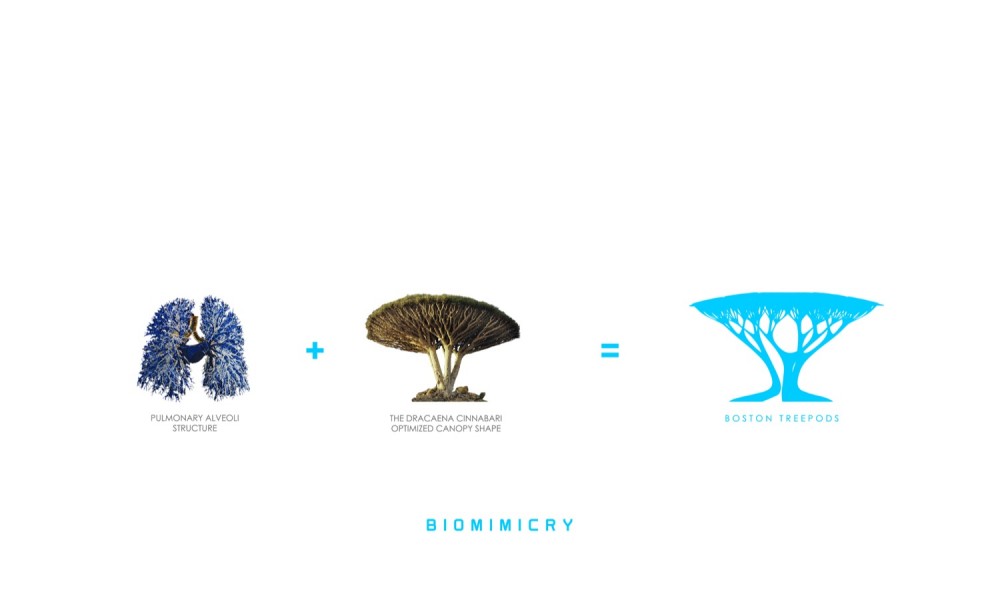
Boston's Treepods inspired by the Dragon's Blood Tree
Paris-based Influx_Studio are developing a new concept of artificial urban tree which absorbs Co², called TREEPOD. The proposal could be defined as a CO2-scrubbing living machine. The artificial trees don’t replace the natural ones, but they act like small urban “air cleaning infrastructures”. The design of the treepods was inspired by the the Dragon's Blood Tree, the shape of which is optimal for providing a shading canopy.
The Treepod Initiative is a sustainable project lead by Influx_Studio and ShiftBoston. The aim of this collaboration is to allow the achievement of Boston’s global goals in terms of carbon reduction programs in the short time, allowing enough time to make the change from the present fossil fuel economy into a new Zero carbon energy economy. | Dragon's Blood Tree. Image via http://en.wikipedia.org/wiki/File:Socotra_dragon_tree.JPG |
Advanced technologies are actually already developed that allow the capture of the atmospheric carbon dioxide from ambient air in an efficient, economic and sustainable way. Developed by Dr Klaus Lackner, Director of the Lenfest Center for Sustainable Energy at Columbia University, this process is based on the discovery of the ‘humidity swing,’ a technology that enables the energy-efficient capture of CO2 from air, allowing to close the carbon cycle and creating a valuable product for beneficial use. You can read more about how the ´humidity swing´ works here. The treepods have photovoltaic panels integrated into their canopy, and the energy thus produced is used to power the CO2 filtering system and also LED lights at night.
Concept images via Archdaily.
// Satu
Moloch horridus (or how to optimize moisture harvesting and water transport in desert environment)
Moloch horridus is a species of lizard with an array of spikes covering the entire upper side of its body. It can be found in desert climate of western Australia. It grows up to 20 cm (8 in) in length and can live up to 20 years, coloured in camouflaging shades of desert browns and tans;
Few birds could relish such a thorny mouthful and to that extent, they must be a very effective defence, but the shape of the scales also serves another and most unusual function. Each is scored with very thin grooves radiating from the central peak. During cold nights, dew condenses on them and is drawn by capillary action along the grooves and eventually down to the tiny creature's mouth." (Attenborough 1979:164)
Here is a comparison between a non-moisture harvesting lizard and a Moloch, when a droplet of 5 µl was applied through a syringe and brought into contact with the surface by the use of a micro manipulator. On Moloch´s back within 2 s the water is completely spread on the surface structure.
Finally, how liquid flows towards moloch's mouth (on the right side of the picture).
// sara
Subscribe to:
Posts (Atom)